
Key takeaways
- Native 4K UHD delivers four times the pixel count of 1080p, so a small drone at 1,500 meters resolves as a 64-pixel target instead of a 16-pixel smudge.
- In counter-unmanned aircraft system (counter-UAS) engagements, that added detail converts directly into standoff distance and decision time.
- The Spectra Defense Technologies ARD series is qualified to MIL-STD-810H and MIL-STD-461G, with IP66 protection against dust and water.
- Combines a high-brightness backlight with optical bonding and front-surface AR/AG coatings to neutralize glare and preserve 4K clarity, while passive thermal management ensures continuous full-duty operation without active cooling.
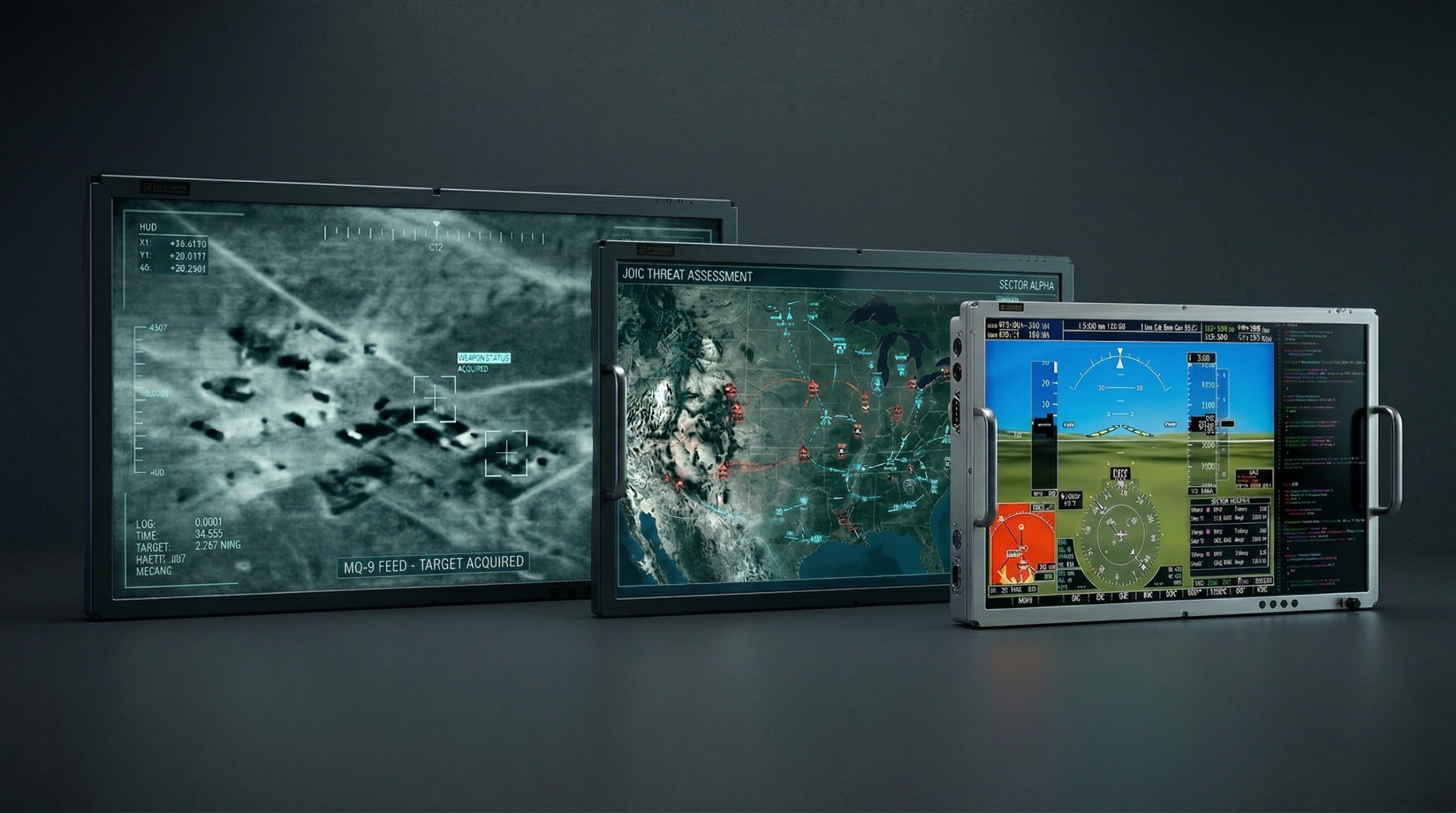
- Three sizes share one core architecture: ARD24, ARD27 and ARD32. Selection comes down to available platform real estate.
- One display family supports fire control, ISR analysis, flight test instrumentation, Blue Force Tracking and real-time situational awareness across air, land and sea.
A Fire Control Officer (FCO) in an armored vehicle is watching a legacy 1080p display, and the screen is full of noise: birds, wind-blown debris, drifting smoke. Somewhere in that clutter is a small first-person-view drone closing at 1,500 meters. On a standard HD screen, that drone occupies a 4×4 pixel block, not much more than a smudge. By the time the FCO can visually confirm it as a threat instead of a bird, the drone may already be in its terminal dive.
This is the detection-to-engagement gap, and it’s the problem Spectra Defense Technologies’ ARD series of 4K displays was built to close.
The problem with legacy glass
Military platforms don’t get climate-controlled server rooms or a quiet desk. Displays here have to survive cold-soak conditions as low as -55°C, solar loading, constant vibration, salt fog and chemical washdown. Commercial displays weren’t built for it, and neither was legacy 1080p glass.
The result is a widening gap: Sensors keep getting sharper, but the screens operators use to interpret that data haven’t kept pace. That gap costs time, and in mission-critical scenarios, time is often the only thing standing between detection and defeat.
What 4K actually buys the operator
Resolution isn’t just a nicer picture. It’s standoff distance.
4K UHD is 3840 x 2160, exactly double 1080p in each dimension. Across the same field of view, a target spans twice as many pixels horizontally and vertically, which is four times the pixels on the threat.
Going back to that FCO station, now upgraded with an ARD27 ruggedized 4K display linked to a high-fidelity electro-optical/infrared (EO/IR) gimbal. The same drone at 1,500 meters that occupied a 4×4 pixel block on HD now resolves as an 8×8 block, four times the pixel information on the same target and enough for the FCO to identify structural silhouette and payload meaningfully earlier than before. The screen quad-splits to show a wide-angle situational camera, a narrow-field 4K spotter view, an AI-driven threat table and fire control symbology, all without sacrificing clarity in any pane.
The FCO identifies the lead threat at 2,000 meters instead of losing precious seconds to visual confirmation, places the reticle with precision and engages. Immediate battle damage assessment follows in the same 4K feed, and the FCO shifts focus to the next target without delay.
In counter-UAS operations, resolution = distance = time.
Built to survive, not just to display
None of that pixel density matters if the display fails in the field. The ARD series is engineered around the environments it has to survive in: MIL-STD-810H and MIL-STD-461G qualification, shock and vibration tolerance across naval, airborne and ground-mobile profiles, and IP66 protection against dust and water. Optical bonding and anti-glare coatings keep the screen readable in direct sunlight without sacrificing 4K clarity, and passive thermal management keeps the display running at full duty cycle without active cooling.
One family, three sizes
The ARD24, ARD27 and ARD32 share the same core architecture. The decision between them comes down to available platform real estate:
- ARD24: the most compact footprint, suited for space-constrained installations, airborne consoles and multi-display arrays
- ARD27: a versatile mid-size option for fire control stations, operator consoles and ISR analyst workstations
- ARD32: the largest viewing area, built for command centers, Combat Information Center consoles and mobile command posts
Multi-domain by design
The same display architecture supports every domain. It drives airborne fire-control, ISR video analysis and flight test instrumentation. On the ground, it powers Blue Force Tracking and unmanned vehicle control. At sea, it integrates electronic charting and tactical situational awareness. One platform, deployed wherever the mission requires it.
Proven in the field
The ARD family builds on Spectra’s heritage delivering display solutions for some of the most advanced airborne early warning and control (AEW&C) platforms flown in the U.S. and Europe. That proven performance now extends into native 4K.
Learn more
The ARD series is one piece of Spectra’s end-to-end data continuum, spanning capture, processing and display. To dig into the full technical specifications, environmental qualifications and selection guidance, read the 4K ruggedized display white paper or reach out to Spectra’s engineering team to talk through your platform’s requirements.
Learn more at spectradefense.tech, or contact sales at [email protected].
Frequently asked questions
What is a ruggedized 4K display?
A ruggedized 4K display is a monitor built to deliver 3840 x 2160 resolution while surviving military operating conditions. Unlike a commercial monitor, it is qualified against standards such as MIL-STD-810H for environmental stress and MIL-STD-461G for electromagnetic interference, and it is sealed against dust, water, salt fog and chemical washdown.
Why does 4K resolution matter for counter-UAS detection?
Pixel count on target determines how early an operator can classify a small threat. 4K UHD is double 1080p in each dimension, so a drone that occupies a 4×4 pixel block on an HD display resolves as an 8×8 block at 4K. That is four times the pixel information on the same target, and it is what lets the operator start distinguishing silhouette and payload earlier in the engagement window.
What environmental standards does the Spectra ARD series meet?
The ARD series is qualified to MIL-STD-810H and MIL-STD-461G, with shock and vibration tolerance across naval, airborne and ground-mobile profiles. It carries IP66 protection against dust and water ingress. Specific configurations are qualified to MIL-STD and DO-160 standards, so confirm against the individual datasheet for a given program.
Can a 4K military display be read in direct sunlight?
Yes. Sunlight readability depends on overriding ambient glare by pairing a high-brightness backlight (typically 1,000+ nits) with advanced surface treatments. High-performance anti-reflective (AR) and anti-glare (AG) coatings on the cover glass minimize front-surface reflections, while optical bonding eliminates the internal air gaps that cause secondary reflections. Together, these technologies preserve the high contrast required to maintain 4K clarity under extreme solar loading.
Do ruggedized 4K displays require active cooling?
The ARD series does not. Passive thermal management keeps the display running at full duty cycle without fans or other active cooling, which removes a common failure point and eliminates the ingress paths that cooling vents introduce.
What is the difference between the ARD24, ARD27 and ARD32?
Viewing area. All three share the same core architecture, so the choice is driven by available platform real estate. The ARD24 fits space-constrained installations and multi-display arrays, the ARD27 suits fire control stations and ISR analyst workstations, and the ARD32 is built for command centers, Combat Information Center consoles and mobile command posts.
What platforms use the ARD series?
The ARD series deploys across air, land and sea applications, including ISR video analysis and flight test instrumentation in the air, Blue Force Tracking and unmanned ground vehicle control on the ground, and Combat Information Center integration and electronic charting at sea.
Why not use a commercial 4K monitor in a military vehicle?
Commercial displays are not built for cold-soak conditions, solar loading, constant vibration, salt fog or chemical washdown, and they are not qualified for the electromagnetic environment of a military platform. A commercial panel may match the resolution, but it will not survive the duty cycle or the environment.