
At Spectra Defense Technologies Las Cruces, technical writer Patrick Landry spends his days translating complex engineering knowledge into clear, usable documentation for customers. It is a job that draws on skills he first developed in a very different environment: as an Army medic responsible for keeping soldiers alive in the field.
Landry processes supplier data requirements lists (SDRLs), a category of documentation that spans acceptance test procedures, manuals and requirement traceability verification matrices. His job is to take the expertise of Spectra’s engineers and turn it into accessible, technical language that customers can act on.
“Our writing office emphasizes formatting, styling and continuity for clear, concise data presentation,” he said.
His path to the role was not a straight line. Landry holds an Associate of Science in Health Sciences from Kaplan University, a Bachelor of Arts in English from Montana State University-Billings and a Master of Public Administration from Vermont’s Norwich University. He moved to Las Cruces, New Mexico from Montana in 2023 after accepting a technical writing position with an Army agency conducting combat analysis. Here, he was introduced to publication-level white papers written by Army officers. That experience, he said, bridged the gap between academic theory and practical, professional writing.
Nine months from writer to program manager
Landry joined Spectra as a technical writer in June 2025. Within nine months, he stepped into a program-manager role, a shift that gave him exposure to new business processes, scheduling and delegation skill. It also afforded him a front-row seat to how ideas move from abstract concepts to finished technical products.
Asked what he enjoys most about the work, Landry pointed to the challenge itself. “What I enjoy most are the trickier problems. It’s like doing jigsaw puzzles without the box top image to refer to,” he said.
That mindset extends to how he thinks about the broader field.
“Technical writing involves several steps: asking questions, applying a critical lens to research and exploring your intuition,” Landry said. “Well-informed decisions about the data we include require a lot of collaboration, and it’s easy to get bogged down in the sheer volume of information available. It takes boundaries, understanding when the most-right answer is in front of you and knowing when to stop writing.”
A career built on serving something larger
Before Spectra, Landry served in the active-duty Army and the Montana Army National Guard as a medic, work he describes as preserving the fighting force. He sees a direct line between that mission and his current one in the defense industry.
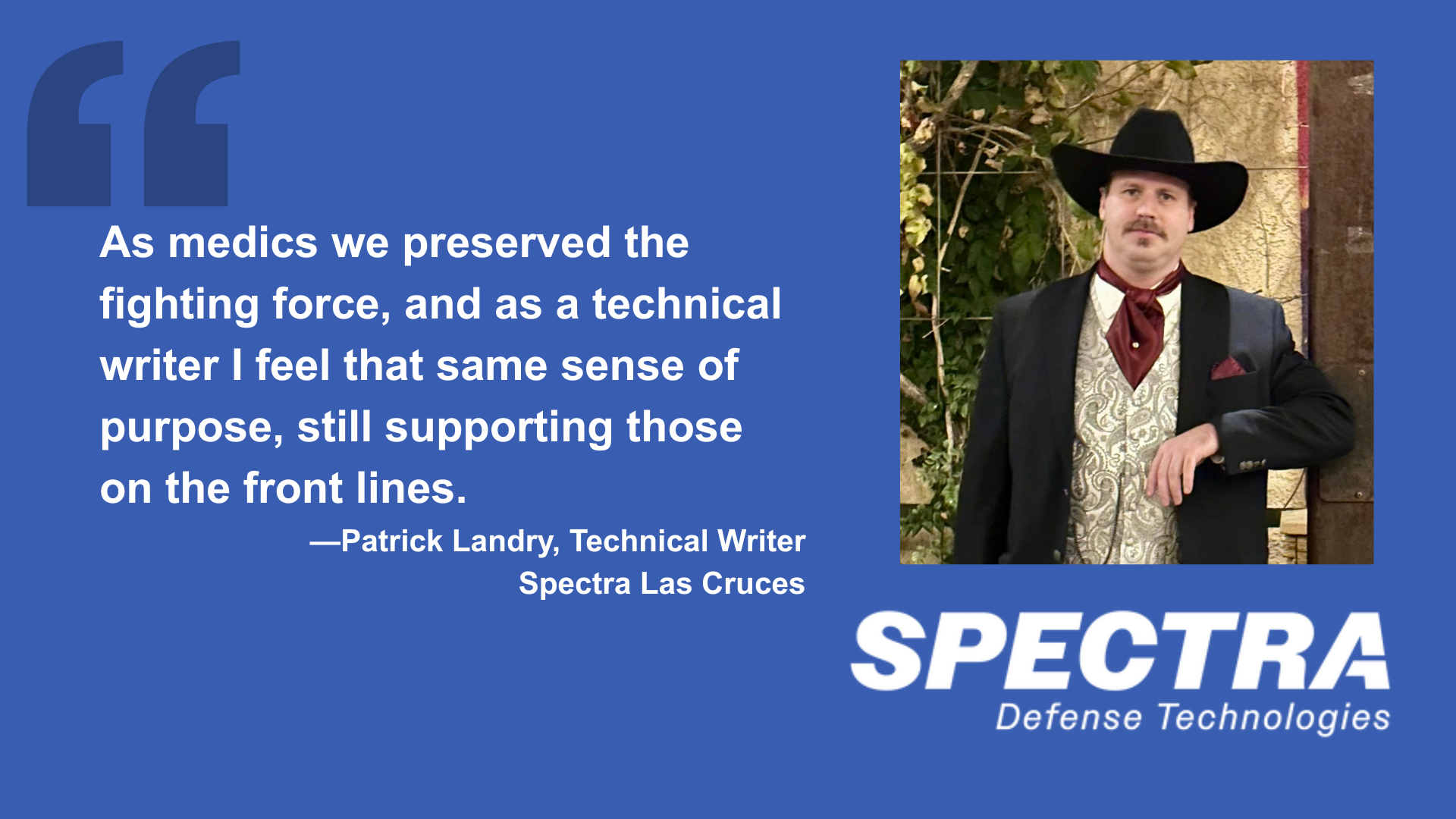
“As medics we preserved the fighting force, and as a technical writer I feel that same sense of purpose, still supporting those on the front lines,” he said.
That sense of mission, paired with high standards, is what drew him to the defense and aerospace sector in the first place. It’s also what he finds most rewarding about the industry overall: its blend of public- and private-sector work, and the constant exposure to new developments in modern warfare, automation, manufacturing and data centers.
Landry is especially interested in the growth of automation and remote vehicles, a trend he sees as central to the future of the field. But human-controlled vehicles will always have a place.
“If the medevac ever becomes remote, I’m not sure I’ll trust a robot over an actual medic,” he said.
He professes a lasting fondness for the M113 armored medical evacuation vehicle, which he described as feeling like an enormous go-kart to drive and a sarcophagus to sleep in during field exercises.
Learning the business behind public service
Before joining Spectra, Landry’s career had been rooted entirely in public-service roles: Army medic, fire department secretary, library clerk. Working for a company that manufactures physical products was new territory.
“Being part of a team that still provides a public service through its products feels different,” he said, adding that it has given him a better understanding of the private-sector management techniques behind public defense administration.
For Landry, the purpose behind the work is the point. “Technical writing isn’t about writing; it’s about enabling people to succeed,” he said.
Beyond the office
Outside of work, Landry keeps a sketchbook to practice ink drawing, using techniques like cross-hatching and stippling. He is currently playing “Assassin’s Creed Valhalla” and enjoys the series’ blend of real history, religion and mythology. He is also a longtime fan of Batman, crediting Bruce Wayne’s wealth, as much as his strength or agility, as the real superpower.
Landry keeps a memento on his desk at home: a plastic skull, a nod to the “memento mori” tradition of scholars and saints who kept similar reminders as a way to stay humble and grounded. It is fitting advice for someone who has spent a career balancing high standards with a steady sense of purpose, whether preserving the fighting force in the field or enabling customer success one document at a time.