
Forty years ago, engineer and New Mexico State University graduate Martin Small started a company in his hometown. His aim in founding Calculex in Las Cruces in 1986 was to build real-time, high-speed data acquisition hardware and software for air, sea and ground environments.
Small never saw the company as just a builder of rugged boxes. From the beginning the challenge was the full chain: acquire the data, record it, process it and route it where it needs to go, in real time, on a moving platform.
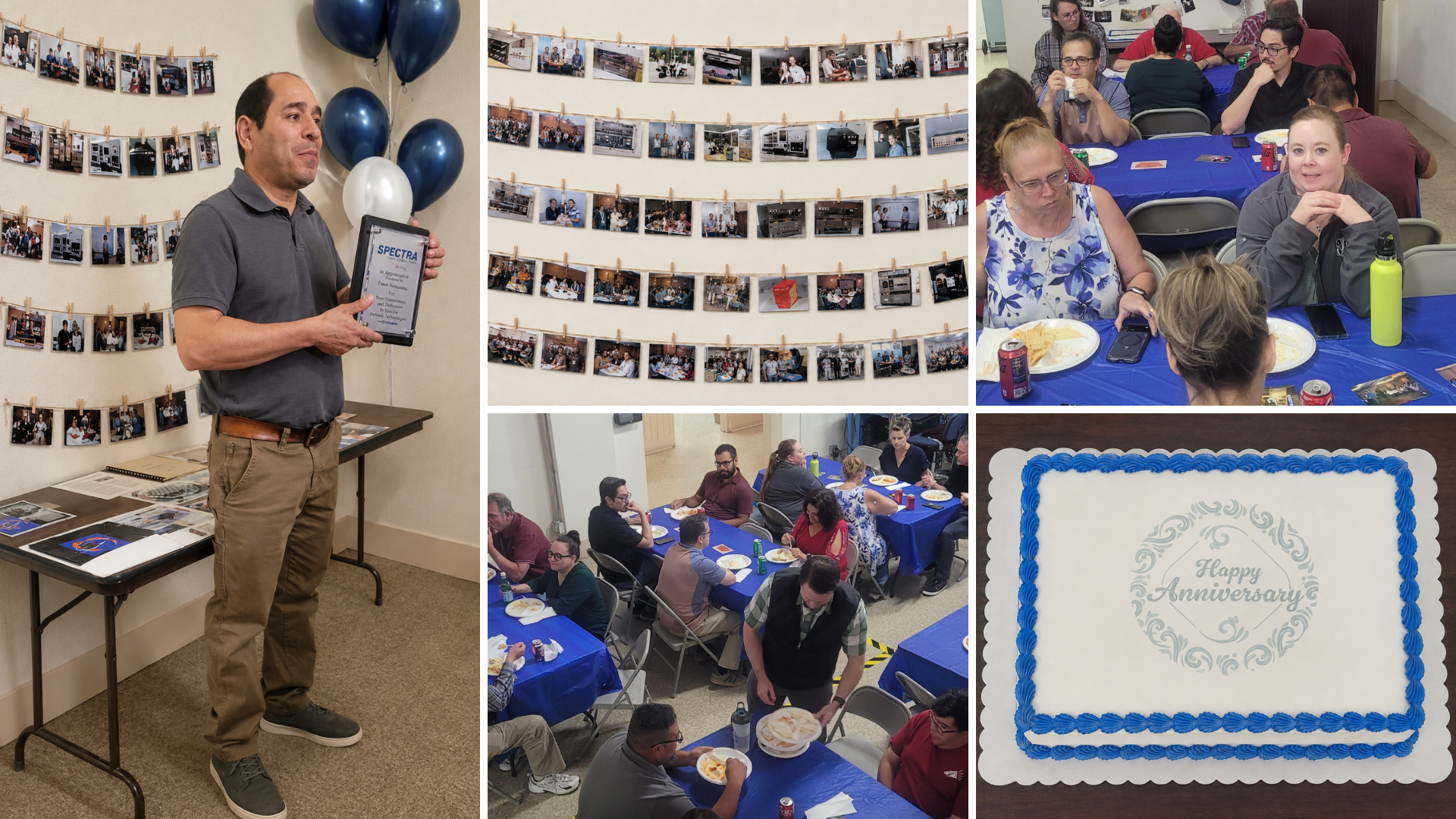
At a celebration held Aug. 6 marking the 40th anniversary of Calculex’s founding, Small returned to Las Cruces to walk employees through that early history. Surrounded by photos, early hardware and memorabilia spanning four decades, he traced the path from the first product built on site to the systems shipping today. The event also included the presentation of the first Martin Small Founders Award to product test lead Sergio Favela, establishing an annual tradition recognizing employees who embody that same spirit of innovation and commitment.
For Michael Judy, vice president and general manager, four decades in one specialty is the asset customers are buying.
“We understand the product, we understand the industry and we understand the needs of the customer,” Judy said. “We bring 40 years of experience into the product line, and our customers look to us for that expertise.”
From data acquisition to integrated mission systems
The progression from data acquisition to integrated mission systems is easy to trace through the product families.
ARMOR, the Asynchronous Real-time Multiplexer and Output Reconstructor, moved the company into advanced telemetry and high-rate digital instrumentation recording. ARMOR II systems were fielded on platforms including the B-2. The technology reached more than 25 U.S. fixed and rotary-wing platforms spanning fighters, bombers, attack helicopters, transports, UAVs, ISR and special mission aircraft. Three Calculex inventions became U.S. government standards, among them the ARMOR multiplexing format and IRIG 106 Chapter 10, which the company co-authored with the Air Force.
MONSSTR, the Modular Non-volatile Solid State Recorder, moved that work into rugged solid-state recording built around the IRIG 106 Chapter 10 data packet format, in a package that reduced the size, weight and power the host platform had to give up. Many MONSSTR, SPIDR and ARMOR systems remain fielded more than 20 years later.
Today the RIPR 1400 series moves that lineage forward as a stackable, reconfigurable recorder, integrated processor and router with expandable data acquisition modules and AES-256 encrypted storage. RAPTOR extends the line into high-bandwidth sensor capture.
Tony Bencomo, director of operations, has watched that advance for 16 years.
“We used to stack memory boards on top of memory boards on top of memory boards just to get to the capacity that customers needed,” Bencomo recalled. “Now a drive about an inch thick and 3 inches long holds what used to take all of those boards.”
The demand keeps growing.
“Every program is trying to record more data from the aircraft, and every new sensor adds to that,” Bencomo said. “Keeping pace with it is the whole job.”
What full-data recording is actually for
The F-15 program shows why the capability matters beyond the test range.
In October 2006, Calculex won a competitive bid to replace tape-based flight-test video recorders in the Air Force test fleet at Eglin AFB. Those units were later expanded into flight data recorders with MIL-STD-1553B connections and crash-survivable memory.
The F-15 System Program Office then deployed the recorders across the F-15C/D fleet, with similar capability delivered to the F-15E fleet. Those units are still supported.
Why customers trust Calculex
For a company of its size, competing in a market shaped by the primes comes down to trust and depth.
“A lot of it has been the relationships that we’ve fostered with our customers,” Bencomo said. “You have them coming into our building saying, ‘Here’s my problem, how can you help me fix this?’”
Judy sees the same dynamic from the other side of the table.
“Customers often know what they need at a broad level, and they look to us to bring the detail,” Judy said. “We can tell them here is what you really need to support the mission. That is where the collaboration begins.”
Rachelle Guzman, human resources manager, said those types of partnerships give the company an edge that newer ones don’t have.
“We have these close relationships and decades of experience behind us,” Guzman said. “That’s how we can often anticipate what a customer needs, even when they haven’t asked for it specifically.”
What does not show up on a datasheet
Guzman is approaching 12 years at the site. Bencomo is at 16. Neither is unusual, and a second generation is coming in behind the first. Favela works alongside his son Christopher, an electrical engineering intern. Benita Tinajero started as a summer solder tech more than 30 years ago and now works alongside her son Alex, an electrical engineer. Both families told their stories in an earlier post on two generations at Calculex.
“We have always treated the people who work here as more than employees,” Guzman said. “They never feel like they have to choose between work and their families.”
For Bencomo, that focus on the employee experience directly translates into customer satisfaction.
“It’s the people who really make us special,” he said. “We have team members here who will do whatever it takes to get something out the door for a customer.”
The next 40
Calculex became part of Spectra Defense Technologies in February 2021, and the site operates today as Spectra Las Cruces. Next-generation recorders are in design and development. For people who have been there through several eras of the technology, the change reads as continuity.
“We’re changing the name and we’re changing the way some things look,” Guzman said, “but at the core our values are staying the same.”
Judy framed it in similar terms.
“That history is what got us here,” he said. “We’re going to leverage that history to launch us into the future.”